

From March 11–12, 2025, iHub – AWaDH at IIT Ropar successfully organized a two-day workshop on “Transforming Agriculture with IoT, Automation & Smart Irrigation.” Held at Khalsa College of Engineering and Technology, Amritsar, the event was a part of our ongoing efforts to promote innovation in Cyber-Physical Systems (CPS). The workshop, supported by a grant under our Ideathon Scheme, brought together students, researchers, and professionals to explore how technology can revolutionize the agricultural sector. Participants gained valuable insights into leveraging IoT sensors, automation systems, and smart irrigation techniques to enhance crop yield, conserve water, and improve overall farm efficiency. We are proud to have supported this initiative, which aligns with our mission to empower the next generation of innovators and foster a sustainable future for Indian agriculture.
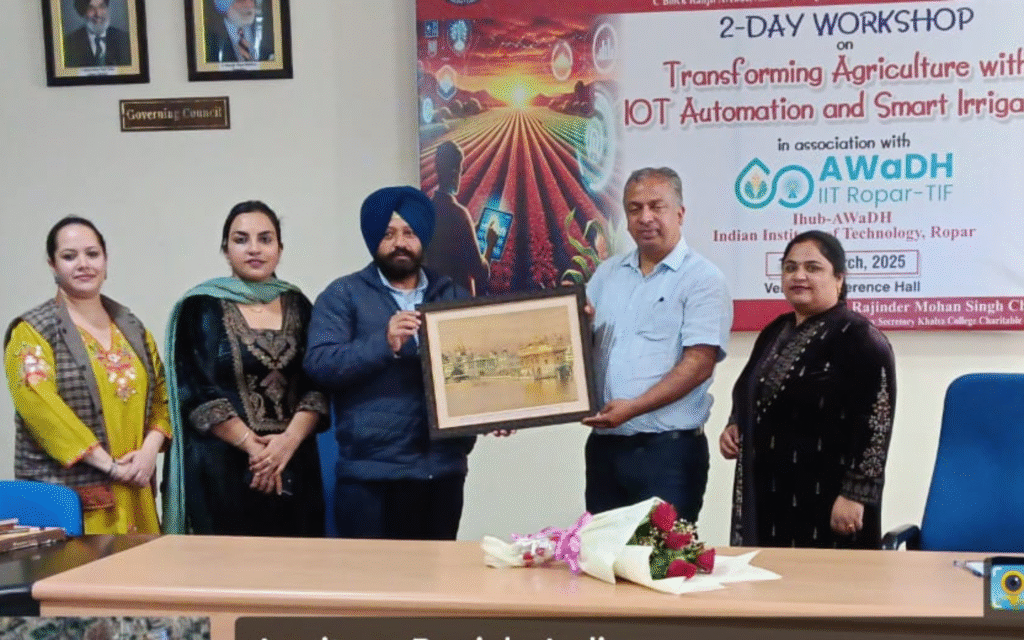
Day 1: March 11, 2025
The first day of the workshop began with a technical talk by Dr. Sandeep Kumar Sood, Professor, Department of Computer Applications, NIT Kurukshetra, on “Smart Agriculture using IoT”. He highlighted the integration of IoT, automation, and sensor networks in agricultural systems. His session focused on the potential of modern technologies in enhancing crop productivity, resource efficiency, and real-time monitoring of farm parameters.
Following this, Mr. Tanishk Singhal, Firmware Engineer at Bhavaya Technologies, conducted a hands-on technical session. He introduced participants to practical applications of sensors in agriculture, such as virtual fencing, livestock monitoring, and sensor interfacing with Arduino. Participants gained practical knowledge of how to configure and deploy sensors like soil moisture sensors, temperature sensors, and RFID modules for precision agriculture applications.
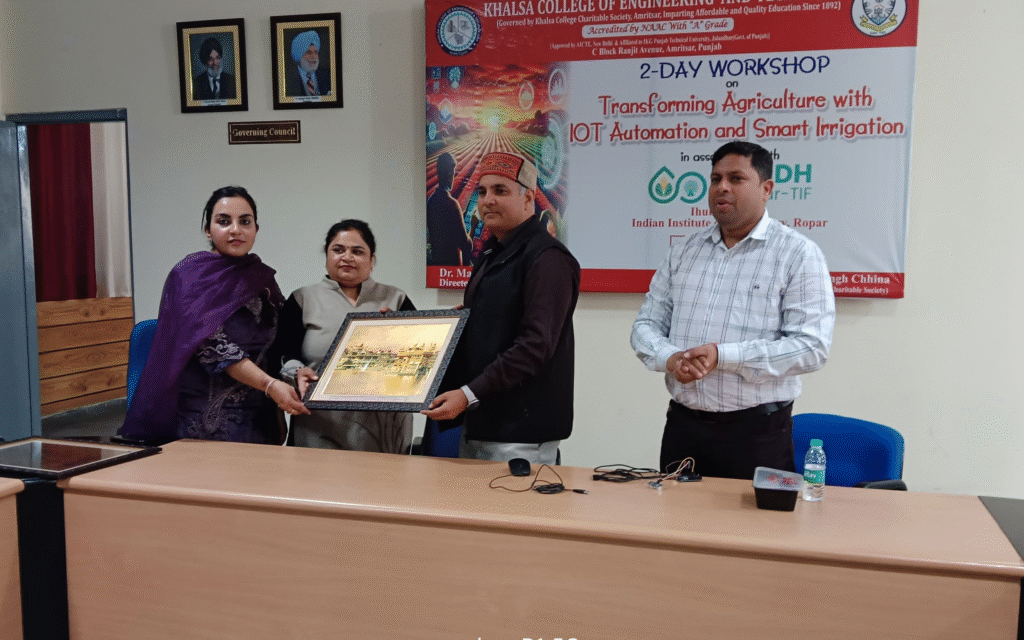
Day 2: March 12, 2025
The second day featured an expert session by Dr. Dilip Kumar, Associate Professor, SLIET Longowal, who delivered a detailed lecture on “Drip Irrigation Systems and Automation in Agriculture”. He explained the structure and functioning of automated irrigation systems and demonstrated how environmental sensors can be used to conserve water while ensuring optimal crop health.
The hands-on session led by Dr. Dilip Kumar included demonstrations of ultrasonic sensors, soil moisture sensors, and temperature sensors, showing participants how these devices can be integrated with controllers for automated drip irrigation. The session allowed students to understand sensor calibration, data acquisition, and real-time implementation of IoT systems in farming.
The workshop was attended by undergraduate and postgraduate students of Computer Science and related disciplines. It provided an excellent platform to bridge theoretical learning with real-world IoT applications in agriculture.